
Use, Care & Safety Instructions for Cutlery
General Safety
- Always use caution when handling cutlery items. Misuse of cutlery may result in personal injury.
- Ensure that cutlery blades are always sharp. Dull knives are more difficult to use and may cause personal injury. Do not test sharpness with hand or fingers; test on a food item.
- Do not allow children to play with the cutlery.
- Always carry cutlery items with the blade pointing away from your body.
- Always cut or slice away from your body.
- Never try to catch falling cutlery.
Cleaning and Storage
- Before first use and after each use, hand wash each knife separately in warm soapy water and rinse. Do not allow cutlery to soak for long periods of time in the sink. Dry cutlery thoroughly with a clean, soft towel.
- Do not use steel wool or harsh abrasives to clean your cutlery.
- Do not place cutlery in the automatic dishwasher.
- Always store cutlery in a cutlery block or sheath to protect the cutting edge and prevent personal injury.
- To clean the knife block, wash with warm soapy water. Do not immerse in water.
Sharpening your knife
- A sharp knife is a safe knife. A dull knife requires you to apply excessive pressure when cutting which increases the likelihood of injury.
- Do not use a knife sharpener or sharpening steel to sharpen knives with serrated edges such as bread knives. They should only be sharpened by a professional.
- Sharpening steels should be used either before or after each use of the knife to hone the blade and maintain the edge. Sharpening stones should be used occasionally to sharpen the knife as it begins to get dull.
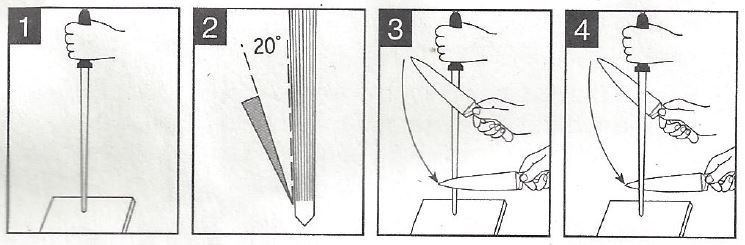
- Hold the sharpening steel with the tip down on a cutting board (see figure 1).
- You should maintain an angle of approximately 20 degrees between the knife blade and the steel (see figure 2). Hold the knife with the sharp side facing down and draw the knife down across the steel in an arc (see figure 3).
- Repeat on the other side of the blade (see figure 4).
- Repeat five to ten times on each side of the blade, alternating sides each time.
Source by: Rachael Ray